
Los Angeles Fun Facts: 25 Surprising Things You Didn’t Know About LA’s History, Geography & Freeways
On This Page:
- Los Angeles Fun Facts
- What’s in a Name?
- What Constitutes “Greater” Los Angeles?
- What is the Elevation of Los Angeles?
- By Population, What are the Largest California Cities?
- How Large in Area is Los Angeles?
- Planning to Rent a Car in Los Angeles? What Do You Know About the Freeway System?
- Fun Facts About LA’s Freeways
- Are You Ready to Visit LA?
5. Los Angeles Fun Facts
It’s common knowledge that Los Angeles is a large American city located in Southern California and is known worldwide for movie and television stars, film studios, sunny beaches, the Hollywood sign, Beverly Hills, and Dodgers baseball.
Whoa! That’s not quite right, because Beverly Hills is a city unto itself, so it isn’t a part of the City of Los Angeles. But yes, it IS located in Los Angeles County; just not within the city limits. Got that?
How much do you really know about the second largest city in the U.S.? Let’s dig deeper to confirm some things that you may already know and explain some misconceptions about the City of Angels.
1. What’s in a Name?
Yes, Los Angeles translated from Spanish means “The Angels”, though its original name which dates back to 1781 from Spanish colonial times was “El Pueblo de Nuestra Senora la Reina del los Angeles del Rio Porciuncula”. Or “The Town of Our Lady the Queen of the Angels of the River Porciuncula”. Personally, I prefer Los Angeles or making it even simpler, LA.
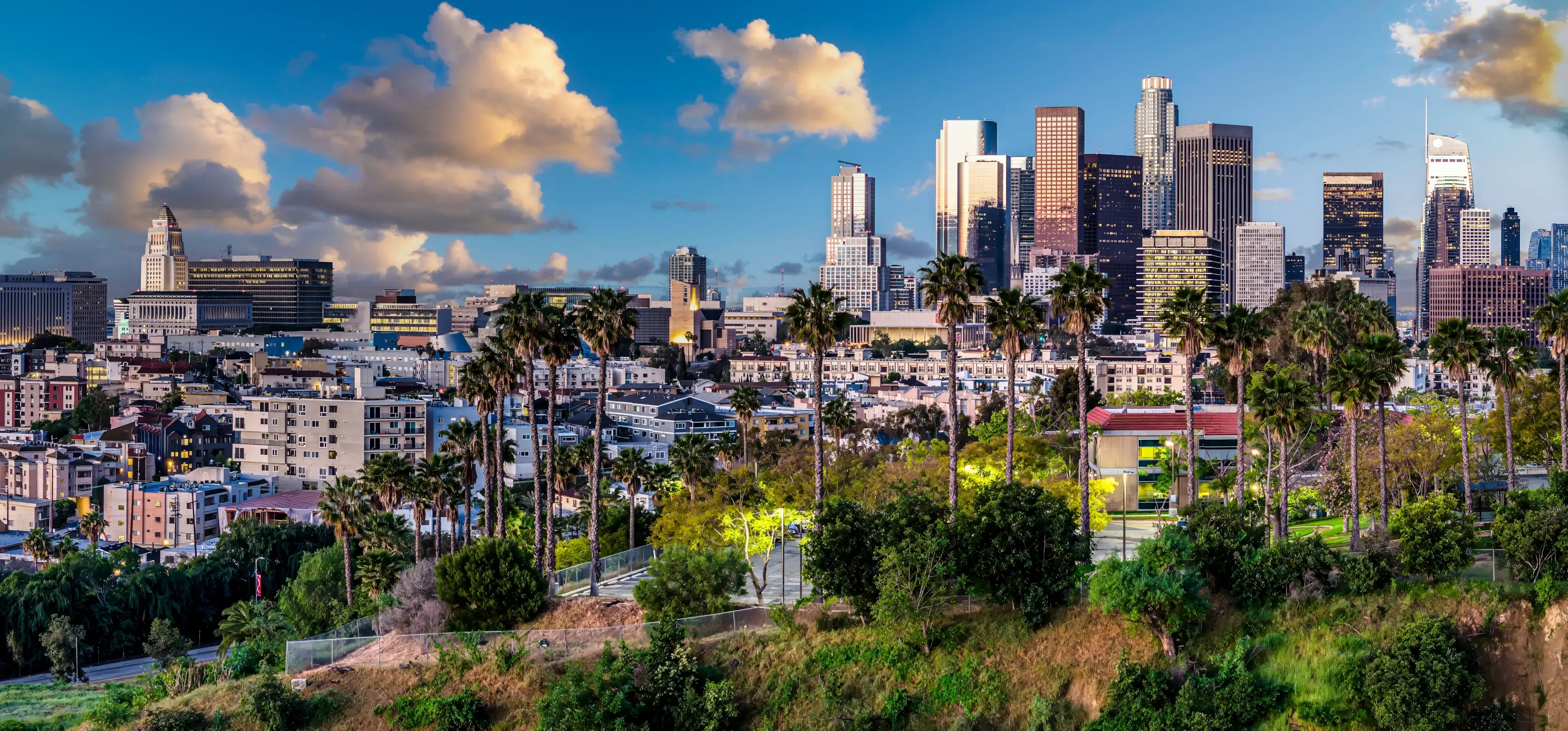
Author: Larry Gibson
Los Angeles California Skyline sunset panorama
2. What Constitutes “Greater” Los Angeles?
Greater correlates to a metropolitan area beyond just the primary city in an area, including suburbs and often other counties and even states. For example, Greater New York City includes the City’s five boroughs, Nassau and Suffolk counties on Long Island, Westchester County to the north, plus an extensive array of suburbs in Connecticut and New Jersey.

Author: Pandora Pictures
Los Angeles, USA. September 20, 2022. Tourists on boardwalk by shops and palm trees in a row exploring Venice beach with clear blue sky in the background during summer
3. What is the Elevation of Los Angeles?
Officially, Los Angeles’s elevation is 277 feet above sea level, based on a measurement taken downtown at City Hall. However, numerous LA communities are located at sea level including Venice Beach, Playa del Rey, Manhattan Beach, and Santa Monica, each of which border the Pacific Ocean.
As for the highest point in Los Angeles, it’s Mount Lukens in the northeast area of the city at 5,074 feet. With the change in elevation of nearly a mile, during winter it is possible to be on the beach in the morning and in the San Gabriel Mountains skiing in the afternoon.
4. By Population, What are the Largest California Cities?
Los Angeles: 3.8 million/12.8 million metro area
San Diego: 1.4 million/3.2 million metro area
San Jose: 969,000/1.9 million metro area
San Francisco: 808,000/4.5 million metro area (includes Oakland)
Fresno: 545,000/1.1 million metro area
Sacramento: 526,000/2.4 million metro area
Long Beach, a city of 449,000 residents is part of the Los Angeles-Long Beach metro statistical area, as is Anaheim with 340,000 residents, though it is located in Orange County.
Not to be overlooked is the separate Riverside-San Bernardino-Ontario metro area just east of Los Angeles, with an additional 4.7 million residents.

Author: Jason Finn
Boat docks and stairs at a calm canal in Long beach California neighborhood
5. How Large in Area is Los Angeles?
The City of Los Angeles occupies an area of 502 square miles, while Los Angeles County is a whopping 4,057 square miles including the heavily populated San Fernando Valley, San Gabriel Valley, and Santa Clarita Valley to the north and northeast. With the addition of Anaheim and other northern Orange County communities, the official Los Angeles Metropolitan Statistical Area is more than 4,800 square miles. It’s no wonder such an enormous area is the world’s 3rd largest metropolitan economy, trailing just New York City and Tokyo.
By comparison, New York City’s land area is 302 square miles, but there are nearly 8.5 million residents living in the five boroughs of Manhattan, Queens, Brooklyn, the Bronx, and Staten Island. In other words, more than twice as many people call New York City home than Los Angeles, but they inhabit 200 fewer square miles than does LA.
If you could look down from above, Los Angeles stretches 29 miles from the eastern boundary to the Pacific Ocean on the west, and 44 miles from north to south. The perimeter if you were able to drive around the city extends for 342 miles.
6. Planning to Rent a Car in Los Angeles? What Do You Know About the Freeway System?
The car is king in Los Angeles and throughout Southern California. While there are public transit options including bus and rail (102 stations over 109 miles in total), the number of people that utilize mass transit here is much smaller than more compact cities like San Francisco, Boston, New York, and Washington D.C., due to the central core of the city being small in relation to the indefinite sprawl.
If you have ever visited San Francisco, think the exact opposite here when it comes to getting around using mass transit. Do you want to walk between destinations? This is practically unheard of in Los Angeles.
With that being said, there are freeways galore in the region, but they don’t necessarily move anywhere close to the speed limit, even during times of day when you may ask yourself, “where are all of these people going at this hour? It isn’t even rush hour.”
Still, the freeways will in all likelihood be the best way to get from point A to point B. If you are traveling with your family or some friends, you will come to savor the designated carpool lanes for vehicles with at least three passengers. Getting across three, four, or even five lanes of traffic to reach the carpool lane can be a challenge, but once you get there just take a deep breath and enjoy the ride. And of course, be well prepared in advance to work your way back across to access your exit.
With a dozen freeways extending for more than 650 miles in Los Angeles County alone (!), it is good to know what the locals call them and where they can take you. Here are some of the busiest:
- “The 101”, also called the Hollywood Freeway/Ventura Freeway for obvious reasons. This is the longest highway in California.
- “The 405”, a bypass auxiliary of I-5 which originates as the San Diego Freeway.
- The Santa Monica Freeway meets the Pacific Ocean after originating in Jacksonville, Florida and passing through Mobile (AL), New Orleans, Houston, San Antonio, El Paso, Tucson, Phoenix, and downtown Los Angeles. It is known as the San Bernardino Freeway as it heads east from LA.
- Harbor Freeway (also known as I-110) north-south from downtown LA to San Pedro.
- Glendale Freeway (also known as State Route 2) originates in downtown Los Angeles to the south and runs northward to the intersection with I-210.
- Interstate 5 or I-5, at the intersection with the 405 there are an unbelievable 26 lanes! “The 5” runs north-south from San Diego to the Oregon border, and beyond.
- Foothill Freeway (also known as I-210), runs from the Sylmar neighborhood of LA east to Redlands.
- Simi Valley Freeway (also known as the Ronald Reagan Freeway or CA-118) is so-named as Simi Valley at the west end is home to the President Ronald Reagan Presidential Library. To the east it connects with I-405/I-5.
- Long Beach Freeway/I-710 is a 23-mile long roadway from the Port of Los Angeles on the south, to Alhambra on the north side of Los Angeles.
- “The 105”/Century Freeway runs east-west between “The 605”/I-605 in Norwalk to El Segundo and Los Angeles International Airport and CA-1(Sepulveda Blvd.).
- Gabriel River Freeway or “The 605”/I-605, is a north-south roadway and major auxiliary bypass of Central Los Angeles. It parallels the Gabriel River for many miles, running from Irwindale in northern LA County to Seal Beach in Orange County.

Author: Chizhevskaya Ekaterina
Los Angeles, California - April 3, 2024: View from Venice Beach showcasing colorful buildings and market stalls along the beach line against a clear blue sky
6. Fun Facts About LA’s Freeways
Did you know that southbound I-5 between Euclid Avenue and I-605 is considered to have the worst traffic in the U.S.? Commuters who follow this route lose up to 89 hours of their life every year just sitting in bumper-to-bumper traffic?
Also disliked due to its workday almost daily gridlock, don’t be surprised to experience rush hour delays like you have never seen before on “the 405”, especially from “the 10” to “the 101” freeways. Stay away at all costs, especially during the morning and afternoon drive times.
Long considered the most challenging freeway interchange in the U.S., the world’s first four-level mishmash of roadways isn’t necessarily a good thing as far as Los Angelenos are concerned. Located at the intersection “the 101” and “the 110”, this amazing jumble of roadways is referred to as the “four-level”.
6. Are You Ready to Visit LA?
Of course you are! And LA is looking forward to your arrival. There aren’t many other places on earth with so much to offer, so your daily options are unlimited. Whether you are traveling alone, as a couple, with the kids or friends, you are in for an experience that you will remember for years to come. For the widest choice of hotels with the best prices throughout the Los Angeles area including Orange County, San Diego, and Palm Springs, visit Travelated.

Cities
Winds in Los Angeles Today: Hourly Wind Forecast, Gust Alerts & Storm Updates (90025 & 90066)
May 19, 2025
Cities
Los Angeles City Hall Guide: History, Observation Deck, What to See & Where to Stay Nearby
May 16, 2025
Cities
14 Fun and Free Things to Do Near Me in Los Angeles – Best Places to Visit Without Spending a Dime
April 29, 2025